The world's #1 provider of
online speech training
online speech training

"Gee, I just love your accent."
Any Brit crossing the Atlantic will have heard that line many times. Like the rest of us, Americans are rarely immune to the charms of an accent different from their own.
There's the amusement value of listening to someone who sounds like they might just punctuate their sentences with "oh, behave". And a British accent can conjure up a stereotype of a polite, droll, self-effacing race. But very few Brits are like Hugh Grant (Grant himself has kicked over the traces of his Four Weddings and a Funeral persona), and Stephen Fry speculates that Americans may be dazzled by the British accent.

"I shouldn't be saying this, high treason really, but I sometimes wonder if Americans aren't fooled by our accent into detecting a brilliance that may not really be there."
Fry - who puts his own melodious tones down to having "vocal cords made of tweed" - made the suggestion after seeing a "blitz of Brits" scoop many of this year's Golden Globes and Oscars.
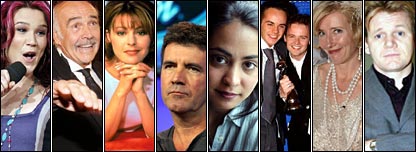
His comments come as a new generation of British stars are trying to prove themselves in the US, while staying true to their regional roots (and more are landing plum jobs in US hit shows with accents other than their own). About to try their luck are Ant and Dec, who will record the pilot of a new ABC game show - not a bad score in a country


 My vocal cords are made of tweed - I give off
an air of Oxford donnishness and old BBC
wirelesses
My vocal cords are made of tweed - I give off
an air of Oxford donnishness and old BBC
wirelesses

where they are best known for a brief cameo playing themselves in Love Actually, and as tone-deaf American Idol contestants playing a joke on judge Simon Cowell, currently the US's favourite pantomime limey baddie.
The network hopes they will enjoy more success than previous imports Anne Robinson and Johnny Vaughan - his 2005 game show My Kind of Town was cancelled after four episodes, with entertainment industry paper The Hollywood Reporter describing the Londoner as "heavily accented (and equally heavily annoying)".
America's most wanted
Another Brit currently feted in the US is Borat creator Sacha Baron Cohen, who gave Rolling Stone a rare interview as himself, rather than in character. The magazine was much taken with his "deep, genteel British accent", which in the UK might be described as educated north London.
"For most Americans, there's no distinction between British accents. For us, there's just one sort of British accent, and it's better than any American accent - more educated, more genteel," says Rosina Lippi-Green, a US academic and author of English with an Accent: Language, Ideology and Discrimination in the United States. "It's a way of speaking that is all tied up with the Old Country, the Queen." This perception extends to any UK accent, she says, divorcing the voice from any regional or class associations it might carry for a fellow Brit.

"There was a sitcom called Dead Like Me with a Brit [Callum Blue] in it. He was a scruffy, 20-something drug dealer. Even he had that sort of patina - his was not an RP accent, it was a working class London accent."
As for Parminder Nagra, plucked from Bend It Like Beckham to star in ER with her soft Midlands accent intact: "Oh, she's thought to be very, very classy, very Oxbridge."
And Simon Cowell, minting it as an American Idol judge? "He's the classic stereotype of a stuck-up Englishman - and stuck-up is something that goes with that perception of Britishness." Little wonder he's found success - the British baddie is a Hollywood staple.
Master and servantAs is the English butler. Henry Pryor, the founder of primemove.co.uk and the Register Of Estate Agents website, worked for Savills International in the late 1980s and early 90s, helping wealthy US buyers purchase flashy dockside apartments, gracious town houses and country piles in the UK.
"Our accents added a huge amount to what they thought they were buying into. This was the age of Four Weddings and a Funeral and Brideshead Revisited - and Arthur, in which John Gielgud played a butler. They approached having an English broker in the same way as having an English tailor or butler - it was a trophy of sorts." And with a classic public school accent, Mr Pryor played up his Englishness. "It added cachet - you were buying a piece of English real estate from a guy who spoke just like Hugh Grant, and might look foppishly like him. I suspect it's the flipside of

what my mother's generation found during World War II - the English seduced by American accents."
Katharine Jones, author of Accent of Privilege: English Identities and Anglophilia in the US, says Britons are unusual among immigrant groups in that when an American can't make out what they're saying, the reaction is generally positive.
"They might say 'cute accent' or 'say something else'. Anyone else would be told 'speak English'."
Then there is the air of authority such a voice carries, hence the number of ads that use English-accented voiceover artists for products such as insurance and mouth wash.
Good neighboursWhereas UK expats in Australia tend to lose their accents quite quickly, those in the US are less likely to, Ms Jones says. "They don't have as much incentive to change because of the perceived benefits - leaving a message in a 'posh' accent about a sought-after apartment and the landlady rings you straight back; the ripped-up parking tickets..."
And the job offers. Strictly Come Dancing judge Len Goodman is currently recording his fourth series of the US version of the BBC show, Dancing with the Stars. He describes his own voice and choice of phrases as Cockney.
 I get asked if I'm Australian
"Part of the reason they wanted me was my accent. Along with Bruno Tonioli, who's Italian, it lends the judging panel a cosmopolitan edge."
But he has modified the way he talks. "I do have to speak more slowly, and I play up to it. I might say 'that wasn't my cup of tea' or 'give it a bit of welly'. They love those quirky phrases."
As one who could never be described as sounding like the Queen, Goodman finds that his regional accent often confuses listeners. "I get asked if I'm Australian."
So does Liverpudlian Alison Walters, an immigration lawyer in Los Angles. But she enjoys feeling unique, and says that people are more friendly, and treat her with respect. "You do get preferential treatment and more of people's time, but I do think that is also down to our manners - saying please and thank you."
Then there's the perception that a British accent equals a brain the size of a planet - a perception reinforced by the not-uncommon belief that for the British, English is a second language. "From time to time I was complimented on how quick I was to pick up the language," says Mr Pryor.
From time to time I was complimented on how
quick I was to pick up the language
Ms Walters adds that as the average American has a hard time following what she's saying, "perhaps the perception of being more intelligent comes from the fact they only understand 50% of what you are uttering".
With planeloads of Brits relocating to the US - not to mention three million tourists who visit the country every year - the stereotype of floppy fringes and plummy vowels must surely be due an overhaul.